
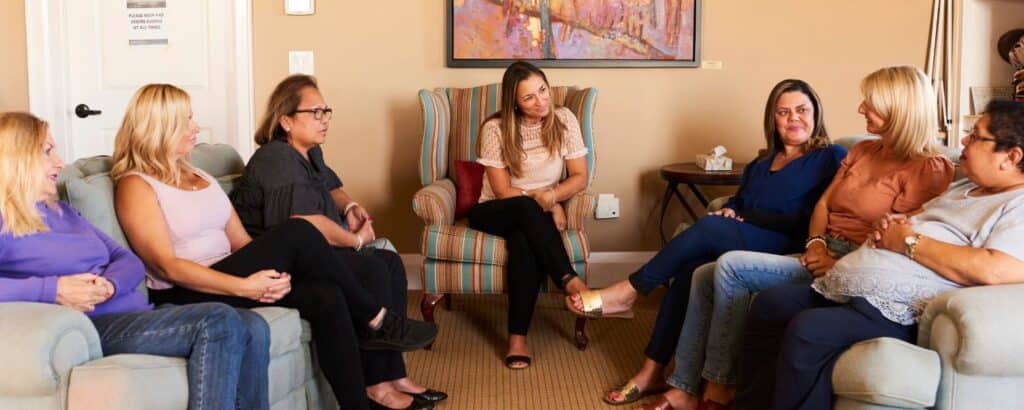
Wellspring uses these two terms deliberately to describe two meaningfully different formats of peer support, so you can find the one that fits your life and your readiness. Support Circles are individual, registered sessions with no long-term commitment required — you come when you’re able, and each session stands on its own. Support Groups run for a defined period of time — typically 6 or 8 weeks — with the same cohort of members meeting weekly, which allows deeper connections and continuity to develop over the course of the program. Both formats are professionally facilitated, free of charge, and designed to reduce isolation, improve coping, and connect you with others who understand the cancer experience from the inside.
Wellspring offers one of the most comprehensive ranges of cancer support groups available in Canada, with programs tailored to specific cancer types, life stages, identities, and circumstances so that you can find a community where the conversations feel immediately relevant to your experience. Current offerings include groups for women with breast cancer (8-week program) and ovarian cancer (6-week program), a Lymphoma Support Group in collaboration with Lymphoma Canada, an Oasis Support Circle for those with advanced or metastatic cancer, a Pancreatic Cancer Support Circle in partnership with Pancreatic Cancer Canada, and dedicated groups for 2SLGBTQIA+ individuals — including separate groups for gay and queer men and for lesbian, queer, bisexual, and gender-diverse women. There are also bereavement groups for those who have lost a loved one to cancer, including a specialized group for those whose loved one chose MAID.
Yes, Wellspring offers two dedicated support groups for members of the 2SLGBTQIA+ community, recognizing that mainstream cancer support groups don’t always feel welcoming or relevant to the unique experiences of queer and gender-diverse individuals. The Support Circle for Gay and Queer Men (including trans, agender, and non-binary individuals) meets monthly for two hours and provides a confidential space to discuss the specific challenges of navigating a cancer diagnosis as a member of the 2SLGBTQIA+ community. The Support Circle for Lesbian and Queer Women (open to trans women, Two-Spirit, non-binary, and gender-diverse individuals) meets once per month for 90 minutes. A University of Toronto literature review commissioned by Wellspring found that 2SLGBTQIA+ cancer patients frequently feel unwelcome in mainstream support groups and face barriers to asking identity-specific questions — these programs exist to remove those barriers entirely.
Yes, Wellspring offers two distinct bereavement support groups for people navigating loss after cancer, because grief after cancer is complex and deserves its own dedicated space. The Bereavement Support Group is an 8-week program with weekly 90-minute sessions for those who have lost a loved one to cancer, offered in two streams when group size permits — one for spousal loss and one for family loss (parent, sibling, or close friend). For those whose partner or family member chose Medical Assistance in Dying, Wellspring also offers a separate MAID Bereavement Support Group, recognizing that this experience can bring feelings and grief that differ meaningfully from other deaths and benefit from a community of people who share that specific context. Both programs are best suited for individuals who are between three months and one year into their bereavement journey, and both are professionally facilitated and fully confidential.
Absolutely, several of Wellspring’s Support Circles are designed exactly for this, with an open, drop-in format that requires no long-term commitment and welcomes new members at any session. The Living with Chronic Cancer Support Group meets weekly or bi-weekly online and uses an open-forum model where members can come and go as their needs and energy allow — there is no minimum attendance and registration is rolling. The Support Circles follow flexible, open formats with regular monthly or bi-monthly sessions — with participants selecting when and how many they want to attend. All are free, professionally facilitated, and confidential.
The research behind professionally facilitated cancer support groups is extensive, consistent, and spans decades across multiple cancer types and group formats. Multiple peer-reviewed studies have found that group support leads to meaningful improvements in quality of life, reduced pain, anxiety, and depression, stronger coping strategies, and in some cases improvements in immune function, treatment compliance, sleep, and family relationships. For bereavement specifically, research has shown that professional support offering confidentiality and a listening environment positively shapes the grieving process for those who have lost someone to cancer. For 2SLGBTQIA+ individuals, a University of Toronto literature review found that identity-specific support groups are particularly important, as community members frequently feel unwelcome in mainstream groups and face distinct psychological challenges that require tailored, empathetic care. What participants across Wellspring’s programs most consistently describe — beyond the clinical outcomes — is feeling less alone, more understood, and more capable of facing what’s ahead.